

 Kayiwa · · 4 min read
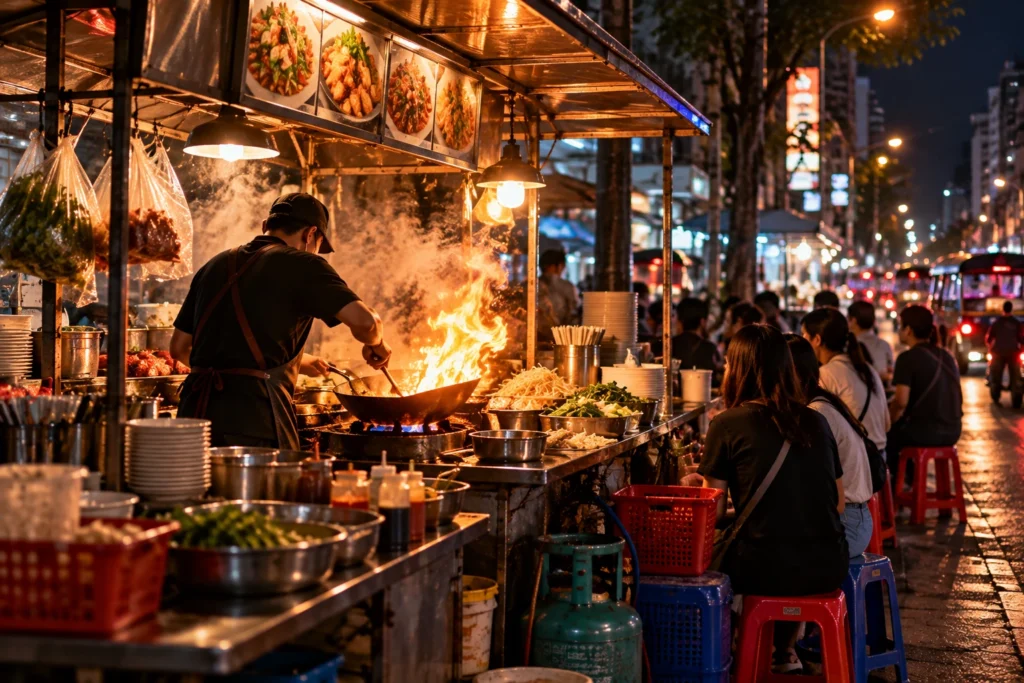
Street food is not a category of food. It is a category of business: one cook, one dish, low overheads, high turnover, priced for people who work. That structure produces better eating than most restaurants for reasons that have nothing to do with romance, and it is the same in Bangkok, Kampala, Istanbul and Mexico City.
Older than restaurants
Eating in the street came first. Pompeii has counters with sunken jars set into them — thermopolia, where Romans without kitchens bought hot food, and there were dozens in a small city. Song dynasty Kaifeng, a thousand years ago, had night markets running past midnight and vendors selling specific dishes to a city of a million people. The restaurant, with its menu and its table service, is the newcomer.
The logic has never changed: cities concentrate people who lack time, space or fuel to cook, and someone will always meet that need at the cheapest workable price. What we now frame as culinary heritage started as infrastructure.
Why one dish beats twenty
The single best thing about street food is specialisation. A stall that has made one dish for thirty years has made it tens of thousands of times, with the same pan, the same supplier and the same hand. A restaurant offering ninety items is ordering from a wider supply chain, holding more stock and cooking most of it less often.
Turnover does the rest. A busy stall sells out daily, which means nothing sits. That is also why a queue is the most reliable quality signal in the world — not because crowds have taste, but because a queue means fast stock rotation and a cook doing the same motion all day.
Heritage, officially
On 16 December 2020 UNESCO inscribed Singapore’s hawker culture on its Representative List of the Intangible Cultural Heritage of Humanity — the country’s first inscription. The citation is not about recipes; it is about hawker centres as community dining rooms where a multicultural city eats in the same room at the same tables.
The other formal recognition came from Michelin. The guide awarded a star to a Hong Kong dim sum shop and, in Singapore in 2016, to a hawker stall selling soy sauce chicken rice for a couple of dollars — the first street stall in the world to hold one. Bangkok followed in 2018 when Jay Fai, cooking crab omelettes over charcoal in goggles, took a star. Whatever you think of the guide, it forced a conversation about who gets taken seriously.
The pressure it is under
Street food is being squeezed almost everywhere, and rarely by demand. Pavement clearances in the name of order and hygiene have removed vendors from central districts in several Asian cities over the past decade. Rents rise, licences tighten, and the stall that could open for the price of a cart and a gas bottle now needs capital.
Succession is the quieter threat. The economics work through very long hours and thin margins, and the children of stallholders who put them through school do not generally want the stall. Singapore names this openly and runs schemes to recruit younger hawkers; other cities simply lose the trade one retirement at a time.
The third pressure is us. Once a stall appears in enough videos, the queue changes composition, the prices drift and the dish gets tuned for visitors. That is not an argument against filming — I do it — but it is an argument for naming the ordinary places too, and for paying the asking price without haggling over the equivalent of small change.
How to choose a stall, anywhere
- One dish, or very few. Long menus at a cart mean reheating.
- A queue of people who live there, especially at the normal local eating hour rather than the tourist one.
- Cooking in front of you, to order, over live heat.
- High turnover of the raw ingredients — you can see whether the pile is going down.
- Somewhere to sit and a bin that gets emptied. Basic, and it correlates with everything else.
- Go at the start of service for freshness or the very end for the last-batch discount. Avoid the dead middle.
On the stomach question: the risk is real but mostly manageable. Hot food cooked to order in front of you is safer than a lukewarm buffet in a hotel. Water, ice and pre-cut fruit are the usual culprits rather than the wok.
Some of the stalls I have filmed: the Sai Mai noodle wok, the Sala Daeng roti stall, five bites in Vientiane and the Bang Ian night market in Ayutthaya.