
Universal, any time of day.
Essentials- Capital
- Vientiane
- Currency
- Kip (₭)
- Language
- Lao
- Best months
- Nov – Feb
- Visa
- 30 days on arrival
- Daily budget
- $32 mid-range
Laos is landlocked, mountainous and has no railway worth the name outside the new Chinese line, which means every journey takes longer than the map suggests. Vientiane to Luang Prabang looks like a morning. It is a full day on a road that climbs and switchbacks the whole way. People who try to fit Laos into four days spend three of them in a minivan.
The food is the least understood in the region. Lao cooking is sour, bitter and herb-heavy, built on sticky rice eaten by hand, fermented fish sauce called padaek, and enormous plates of raw herbs served with everything. Larb is the dish everyone knows, and the Lao version is sharper and less sweet than the Thai one. What surprises people is how much of what they think of as Isaan Thai food is actually Lao.
It is also the quietest place on this list. That is the point.
When to go
Jan: Best time to visit
Feb: Best time to visit
Mar: Mixed time to visit
Apr: Avoid time to visit
May: Mixed time to visit
Jun: Mixed time to visit
Jul: Mixed time to visit
Aug: Mixed time to visit
Sep: Avoid time to visit
Oct: Good time to visit
Nov: Best time to visit
Dec: Best time to visit
Best Good Mixed Avoid
November to February is dry, cool and the clear window — Luang Prabang can drop to 15°C at night, which nobody packs for. March and April bring agricultural burning that turns the north hazy and the air genuinely unpleasant; visibility from viewpoints disappears. The wet season peaks August and September, when southern roads and the Bolaven Plateau turn to mud, though the waterfalls are at their best.
What it costs
| Item | Rate | Total |
|---|---|---|
| Guesthouse room, private, fan or AC | $15 / night | $210 |
| Food and drink | $9 / day | $126 |
| Buses, minivans, slow boat | — | $95 |
| Motorbike hire, 4 days | — | $44 |
| Waterfalls, caves, temple entry | — | $48 |
| SIM, laundry, sundries | — | $24 |
| Fourteen days | $547 |
Laos is cheap to be in and expensive to move around, which inverts the usual arithmetic. Transport is nearly a fifth of the total for distances that would cost a tenth of that in Vietnam. The Vientiane–Boten high-speed railway has changed the north substantially: Vientiane to Luang Prabang is now two hours instead of eleven, for about $30, and it sells out days ahead.
What to eat
Larb
₭25–50k
Minced meat or fish with herbs, lime, chilli and toasted rice powder. The national dish. The Lao version is sourer and hotter than the Thai one, and often served raw — ask for it cooked if that matters to you.
Khao piak sen
₭15–30k
Hand-cut rice noodles in a thick chicken broth, closer to a chowder than a pho. Breakfast food. The best thing to eat on a cold northern morning.
Tam mak hoong
₭15–30k
The Lao green papaya salad — with padaek, which makes it funkier and considerably more pungent than Thai som tam. This is the original.
Ping pa
₭40–80k
Whole river fish stuffed with lemongrass and grilled over charcoal, split open and eaten with sticky rice and jeow dipping sauces.
Or lam
₭35–60k
Luang Prabang stew of buffalo meat, wood ear mushrooms and sakhaan, a peppery woody vine that numbs the mouth slightly. Nothing else tastes like it.
Khao jee pate
₭15–30k
The Lao baguette sandwich — French bread, pâté, pickled vegetables and chilli. Arguably better than the Vietnamese version and far less famous.
Where to base yourself
| Place | Notes | Nights |
|---|---|---|
| Luang Prabang | Temples, the morning market and the confluence of two rivers. Base near Wat Xieng Thong and walk. The most beautiful town in South-East Asia. | 4 nights |
| Nong Khiaw or Muang Ngoi | North on the Nam Ou river, reached by boat. Limestone, kayaking, almost no traffic and no schedule. | 2–3 nights |
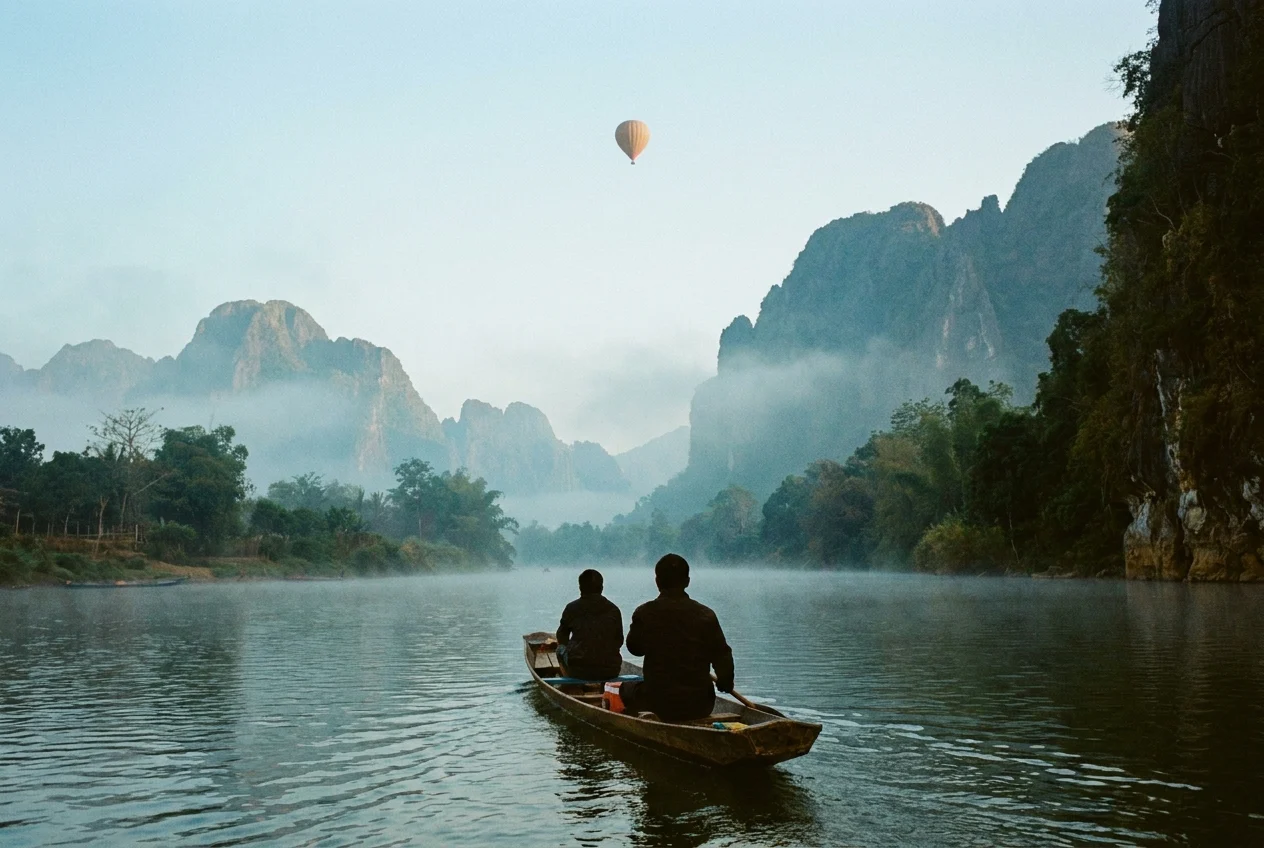
| Vang Vieng | Reinvented as an outdoor town — balloons, caves and lagoons rather than tubing bars. Better than its reputation. | 2 nights |
| Bolaven Plateau / 4000 Islands | The deep south: coffee farms, waterfalls, and Don Det or Don Khon on the Mekong for genuine stillness. | 3–4 nights |
A route that works
Luang Prabang: arrive, walk
Land, drop bags, eat khao piak sen. Sunset from Mount Phousi if you can face the steps.
Luang Prabang: alms and market
The dawn alms procession is at 5.30am and deserves respect, not a flash. Morning market after, then temples before it gets hot.
Luang Prabang: Kuang Si falls
Turquoise pools and a bear rescue centre. Go at 8am, be out by 11 when the coaches arrive.
Luang Prabang: cooking or crafts
A market-and-cooking morning teaches you the jeow sauces, which is the whole key to Lao eating.
Boat north to Nong Khiaw
Slow boat up the Nam Ou, or a bus if the water is low. Either way the pace drops.
Nong Khiaw: viewpoint and river
A hard hour up to the viewpoint, then kayaking or a boat to Muang Ngoi in the afternoon.
South to Vang Vieng
Long minivan day. Break it if you can; the road is beautiful and slow.
Vang Vieng: balloon or caves
Sunrise balloon over the karst, or the Blue Lagoon and Tham Nam water cave by scooter.
Train or bus to Vientiane
The capital is low-key and worth one night, not three. Baguettes and the Mekong at sunset.
Fly or bus to Pakse
The south is a different country — flatter, hotter, more Khmer-influenced.
Bolaven Plateau loop
Two days by motorbike through coffee farms and waterfalls. Tad Fane and Tad Yuang are the big two.
Down to 4000 Islands
Don Det or the quieter Don Khon. Hammocks, bicycles, Irrawaddy dolphins if you are lucky.
4000 Islands: nothing at all
Deliberately empty. This is what people come to Laos for and then forget to schedule.
Back to Pakse, fly out
Or cross into Cambodia at Nong Nok Khiene if you are continuing.
Practical notes
| Visa | Visa on arrival for most nationalities, 30 days, $30–42 depending on passport, paid in cash US dollars at the border or airport. An e-visa is available in advance and smooths the land crossings, which can be slow. | |
|---|---|---|
| Money | Cash only, almost everywhere. The kip has depreciated heavily, so guidebook prices are meaningless and ATM limits are low relative to what things cost. Bring clean US dollars as a backup; they are widely accepted. | |
| SIM | Unitel or Lao Telecom, roughly $5–8 for a month. Coverage is good in towns and patchy in the mountains, which is part of the appeal. | |
| Transport | The Laos–China Railway is the single biggest change in Lao travel — Vientiane, Vang Vieng, Luang Prabang and Boten in hours rather than days. Book through an agent or the LCR app several days ahead. Elsewhere it is minivans, and they leave when full. | |
| Roads | Mountain roads are narrow, unlit and shared with livestock. Do not ride a motorbike at night, and do not take an overnight bus on the northern routes if you can avoid it. | |
| UXO | Laos is the most heavily bombed country per capita in history and unexploded ordnance remains a real hazard in the east and south. Stay on marked paths in rural areas. The COPE centre in Vientiane explains it far better than I can. | |
| Water | Bottled or refill. Ice in towns is generally fine. | |
| Etiquette | Buddhist and conservative. Cover shoulders and knees at temples, never touch a monk if you are a woman, and do not photograph the alms procession from close range or with a flash. Bo pen nyang — no problem — is the national attitude; matching it gets you a long way. | |
Plan this trip
Booking links for the places in this guide, so you can go from reading to reserving without starting a new search.
Where to stay
Getting around
Some of these are affiliate links. If you book through one, I earn a small commission at no extra cost to you, and it never changes what goes in a guide. How this works.
Where your time is better spent
Head for Nong Khiaw or the Bolaven Plateau rather than trying to make Vientiane a destination — the capital is a pleasant one-night stop and no more. And where you might once have gone tubing in Vang Vieng, the caves, lagoons and the sunrise balloon are the versions of that town worth your two days.
If a tour offers close contact with the dawn alms procession, take the quiet version instead: stand well back on a side street, or skip it and go to the morning market. Give the four-day Laos itinerary the same treatment — spend those days in one region and let the country move at its own speed.
Before you book
Visa rules, fees and prices in this guide were checked in September 2026 and they move. Confirm entry requirements with your own foreign ministry and current fees with the relevant authority before committing money.

Bangkok to Laos by train
The direct cross-border train from Bangkok into Laos, from boarding to arrival. If you are coming overland from Thailand, this is what the journey looks like.
Say It Yourself
Back to the route
Twelve phrases in Lao
Lao is tonal with six tones and its own script, but the sounds are close enough to Thai that the two are broadly mutually intelligible in speech. Nobody expects a visitor to try, which is exactly why it lands. Add dai to soften a request, and bo pen nyang — no problem — is the phrase you will hear most often.
Khop jai lai lai for thank you very much.
EssentialsAlso how you get past someone.
EssentialsSay it. Lao food is hotter than Thai.
EatingThe word for tasty. Use it constantly.
EatingPoint while you say it.
EatingKip prices are long. Listen for the thousands.
MoneyMarkets only, never food stalls.
MoneyBor turns anything into a question.
MoneyYoo sai is where.
Getting aroundFor tuk-tuks and songthaews.
Getting aroundMore useful than nodding along.
Getting aroundThe 6 tones, drawn
Mid
level
Low
level, lower
High
level, higher
Rising
climbs
High falling
drops from high
Low falling
drops from mid
One to ten, for price tags
1໑neung
2໒song
3໓sam
4໔si
5໕ha
6໖hok
7໗jet
8໘paet
9໙kao
10໑໐sip
The kip has a lot of zeros and Lao numerals still appear on temple signs and older price boards. Vendors usually quote in thousands — ha sip means fifty, meaning 50,000 kip.
Laos Questions
The four I get asked most
How many days do you need for Laos?
Ten at the very least, two weeks properly. The distances are short on paper and long in practice. If you have five days, do Luang Prabang and the north only, and come back for the south.
Is the new railway worth using?
Yes, and it changes the trip. Vientiane to Luang Prabang drops from eleven hours to two for around $30. Book several days ahead through an agent — tickets sell out and the online system is awkward for foreign cards.
Is Lao food just Thai food?
The influence runs the other way. Most of what visitors know as Isaan Thai cooking — larb, som tam, sticky rice, grilled chicken — is Lao in origin. The Lao versions are sourer, more bitter and use padaek fermented fish rather than sugar.
Is Laos safe?
Yes, with two specific caveats: road safety is poor, and unexploded ordnance remains a hazard off marked paths in the east and south. Petty crime is low. Check current advice for the Xaisomboun area.
Guides like this one are researched in person and stay free to read. If this saved you time or money, you can buy me a coffee.
Never Miss an Adventure
Weekly travel tips, new videos and exclusive guides — straight to your inbox.