Kayiwa · · 4 min read
Korean food is the clearest case in the world of a cuisine that went global on the back of culture rather than migration. There was no centuries-old Korean restaurant diaspora doing the groundwork. There was a pop industry, a film industry and a streaming platform, and a generation who wanted to eat what they were watching.
Fermentation is the whole architecture
Underneath Korean cooking sit the jang: ganjang, soy sauce; doenjang, fermented soybean paste; and gochujang, the fermented chilli paste that gives so much of the food its deep, sweet heat. Soybeans are boiled, formed into blocks called meju, hung to dry and ferment with wild microbes, then submerged in brine. What separates out becomes soy sauce; what remains becomes paste. One process, two products, months of waiting.
UNESCO inscribed jang-making on its Intangible Cultural Heritage list on 3 December 2024, eleven years after it recognised kimjang, the communal making and sharing of kimchi, in 2013. Two entries for one country’s food culture is unusual, and both are for shared practices rather than dishes — the pots on the roof terrace, the neighbours arriving to help, the sharing out afterwards.
Kimchi was white before it was red
Chillies are not native to Korea. They arrived in the late sixteenth century, most likely via Japan, and were not widely used in kimchi until the eighteenth. Before that, kimchi was a salted, brined vegetable preserve — closer to what is still sold today as baek-kimchi, white kimchi, which has no chilli at all and is worth ordering once to understand what the dish was for.
Because the point was never heat. The point was winter. A peninsula with hard winters and a short growing season needed vegetables that lasted, and burying pots of salted cabbage was the answer. Kimjang — the late-autumn mass production of kimchi for the months ahead — is a logistics operation that became a social ritual, and there are now hundreds of regional and seasonal varieties.

Banchan: the table is the dish
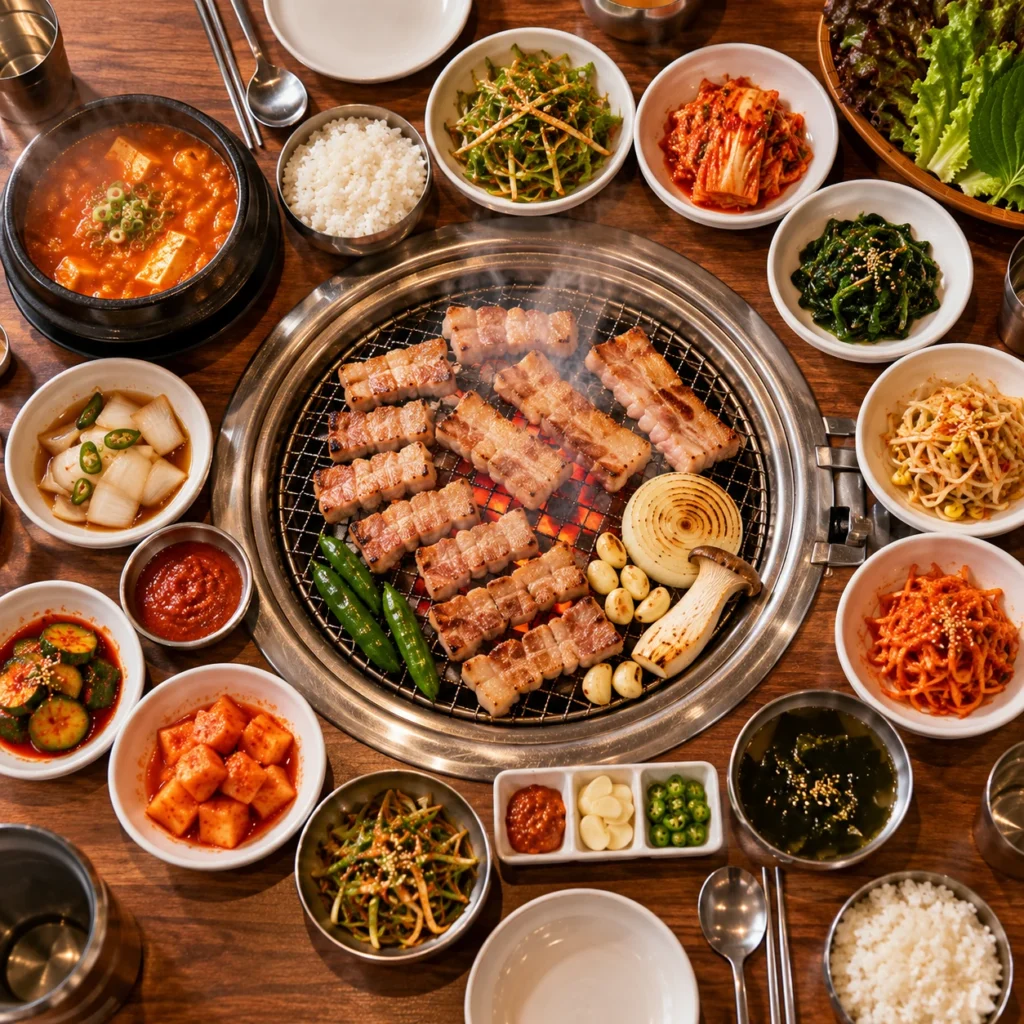
A Korean meal does not arrive as a plate. It arrives as a table: rice, a soup or stew, a main, and anywhere from three to a dozen banchan — small side dishes of pickled, seasoned, braised and fermented vegetables, refilled free of charge. They are not starters and they are not garnish. They are the meal’s structure, providing contrast, acidity and crunch against the rice.
This is also the clearest signal of quality in a Korean restaurant anywhere in the world. Count the banchan, taste two, and you will know how serious the kitchen is before your main course lands.
The other extreme: temple food
Korean Buddhist temple cuisine strips out not only meat but the five pungent vegetables — garlic, onion, spring onion, chives and leeks — on the grounds that they agitate the mind. What remains is a discipline built on wild greens, mushrooms, roots, and fermentation doing the work that aromatics normally do. It is the quietest food in a cuisine known for the loudest, and it has become internationally admired in the last decade, largely through the monk Jeong Kwan.
Exported by culture, not by migration
South Korea began promoting its food abroad deliberately in 2009, through a state-backed hansik globalisation campaign, but the thing that actually worked was the Korean Wave. Music, drama and film carried the food into households that had never met a Korean restaurant: instant noodles after Parasite, fried chicken and beer from a hundred dramas, cooking scenes that function as advertising nobody paid for.
The results are visible. Korean fried chicken is now a global category. Gochujang sits in supermarkets that do not stock any other Korean product. Michelin has published a Seoul guide since 2016. And Korean cuisine climbs most global rankings year on year — which, given those rankings measure familiarity and affection, is exactly what you would expect from a cuisine whose exposure has multiplied in a decade.
What to order
- Doenjang jjigae — the everyday stew, and the fastest way to taste what fermented soybean actually does.
- Samgyeopsal — pork belly grilled at the table, wrapped in lettuce with garlic, ssamjang and rice. Build the parcel, eat it in one.
- Baek-kimchi — white kimchi, for the historical lesson and because it is genuinely good.
- Korean fried chicken — double-fried, thin-shelled, sauced or plain, with beer. The global ambassador dish.
- Bibimbap in a hot stone bowl — press the rice against the sides and wait for the crust.