

 Kayiwa · · 4 min read
American food gets dismissed as burgers and portion size, usually by people who have eaten only the export version. The reality is a set of deep regional cuisines built by Indigenous agriculture, enslaved African cooks, and successive waves of immigrants who arrived poor and cooked their way into the national diet.
The Americas fed the world first
Before any discussion of American cuisine, there is the small matter of what the Americas gave everyone else. Maize, potatoes, tomatoes, chillies, beans, squash, peanuts, vanilla, chocolate, turkey and cassava are all New World crops, and their spread after 1492 rewrote the cooking of Italy, India, Thailand, Ireland, West Africa and China.
Indigenous farming systems built much of that. The three sisters — maize, beans and squash grown together, each supporting the others — is a technique, not a folk story, and it fed large populations for centuries. Any honest account of food in America starts here rather than with colonists.
Barbecue is African, Indigenous and Caribbean before it is Texan
The word comes from barbacoa, a Taino term from the Caribbean for a wooden frame used to cook meat slowly over low fire. The technique arrived in the American South and was then developed, for generations, largely by enslaved Africans who did the pit work — a fact written out of the story for most of the twentieth century and only recently put back.
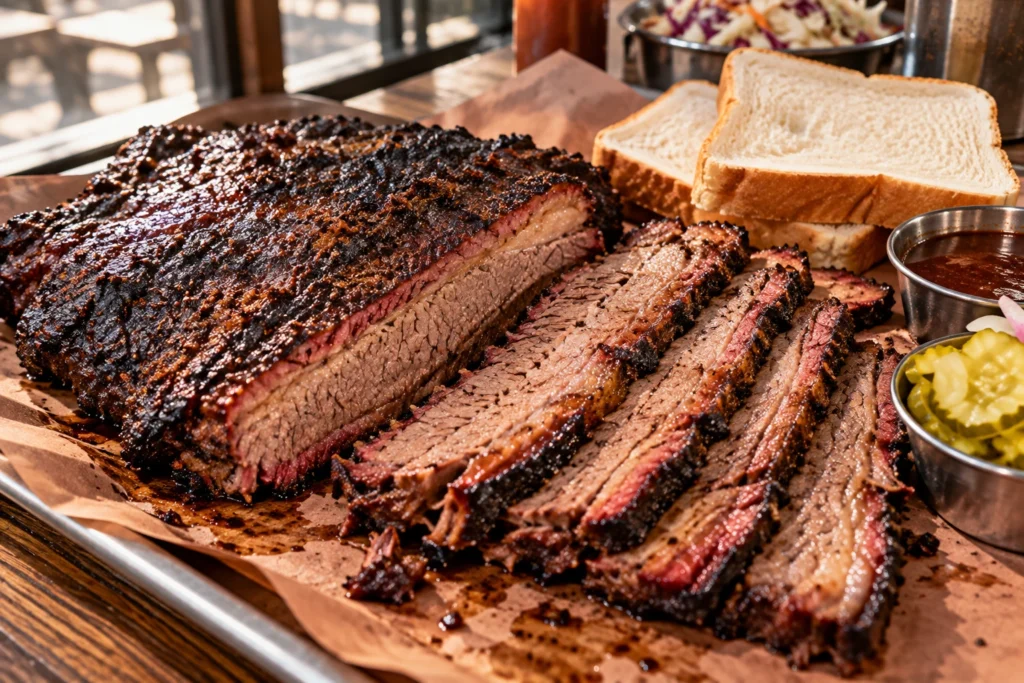
What emerged is genuinely regional and fiercely argued: Texas beef brisket with salt, pepper and post oak; the Carolinas whole hog with vinegar or mustard; Memphis ribs, dry or wet; Kansas City with thick sweet sauce and burnt ends. These are different cuisines that share a heat source.
Soul food has the same lineage and is more direct about it: okra, black-eyed peas, rice, greens and yams are West African staples, carried across in the slave trade and cooked into something new. Carolina Gold rice and the Gullah Geechee rice culture of the Lowcountry exist because enslaved West Africans brought the knowledge of how to grow and cook it.
The immigrant dishes that went national
A striking number of quintessentially American foods were invented by recent arrivals and then absorbed so completely that the origin disappeared. Pizza came with southern Italians and was a neighbourhood food in New York before the war and a national one after it, once returning soldiers had eaten it in Italy. The deli counter — pastrami, rye, pickles — is Central and Eastern European Jewish. Chop suey and the American-Chinese menu were built by Cantonese cooks for non-Chinese customers. Tex-Mex is its own border cuisine, not a degraded Mexican one.
Louisiana is the clearest case of layers producing something new. Creole and Cajun cooking hold French technique, Spanish ingredients, West African okra and rice, and Indigenous filé powder in the same pot. Gumbo is not a fusion dish. It is what happens when four food cultures share a coastline for two centuries.
The format that actually conquered the world
America’s largest culinary export is not a dish. It is a system: standardised menus, portion control, assembly-line kitchens and franchising. The first hamburger chain opened in 1921; the production method that defined the industry arrived in 1948, and franchising took it worldwide.
Judge it as you like — it homogenised diets and it also made the burger, the milkshake and the drive-through global objects. The point for this piece is that it is a genuine American culinary invention of enormous consequence, and it is the version of American food most of the planet has actually eaten. Which is precisely why the country’s regional cooking is so underrated abroad.
Where it stands now
Global cuisine rankings typically place the United States somewhere in the low teens, which is roughly fair if you are measuring the export menu and badly unfair if you are measuring the country. The last two decades have seen the prestige shift toward regional and immigrant cooking — the national restaurant awards now routinely honour taquerias, Vietnamese kitchens, Ethiopian restaurants and pitmasters rather than only fine dining rooms.
What to eat, by region
- Central Texas — brisket, by weight, on paper, no sauce.
- The Carolinas — whole hog with vinegar, and hush puppies.
- New Orleans — gumbo and a muffuletta, in that order.
- New York — a slice folded, and pastrami on rye at a counter.
- The Lowcountry — shrimp and grits made with Carolina Gold.
- New Mexico — green chilli on everything, and the only state with an official question about it.