
 Kayiwa · · 4 min read
West African cooking is the most influential food culture the world refuses to credit. Its techniques and ingredients built large parts of Brazilian, Caribbean and Southern American cooking, and it did so through the slave trade, which is exactly why the credit went missing.
Swallow and soup
The structure across Nigeria, Ghana, Senegal, Côte d’Ivoire and their neighbours is a starch — often called swallow, because you do not chew it much — served with a soup or stew. Fufu, pounded yam, eba, amala and banku are all versions of the same idea: a smooth, elastic starch pinched off by hand, dipped and swallowed.
The soups carry the flavour and they are not subtle. Egusi is thickened with ground melon seed; okra soup is deliberately viscous, which is the point rather than a flaw; groundnut soups are built on peanut; palm oil gives a deep orange-red colour and an earthy, slightly smoky base that nothing else replicates.
Jollof, and the argument
Jollof rice — rice cooked in a tomato, pepper and onion base until it takes on the colour and the smoke — probably originates with the Wolof of the Senegambia region, where the related dish thieboudienne, rice cooked with fish and vegetables, is Senegal’s national plate.
The Jollof Wars between Nigeria and Ghana are conducted largely online and mostly in good humour, with Senegal occasionally pointing out that it got there first. The differences are real: rice variety, the ratio of pepper to tomato, and whether a layer at the bottom of the pot is allowed to catch and smoke. That smoky bottom layer is, for many cooks, the entire measure of the dish.

Fermentation, grilling and the street
Fermentation runs deep: ogi and kenkey from maize, gari from cassava, iru and dawadawa from locust beans, which bring a pungent, savoury depth closer to miso than to anything European. Cassava must be processed to be safe, and the methods for doing so are centuries-old applied chemistry.
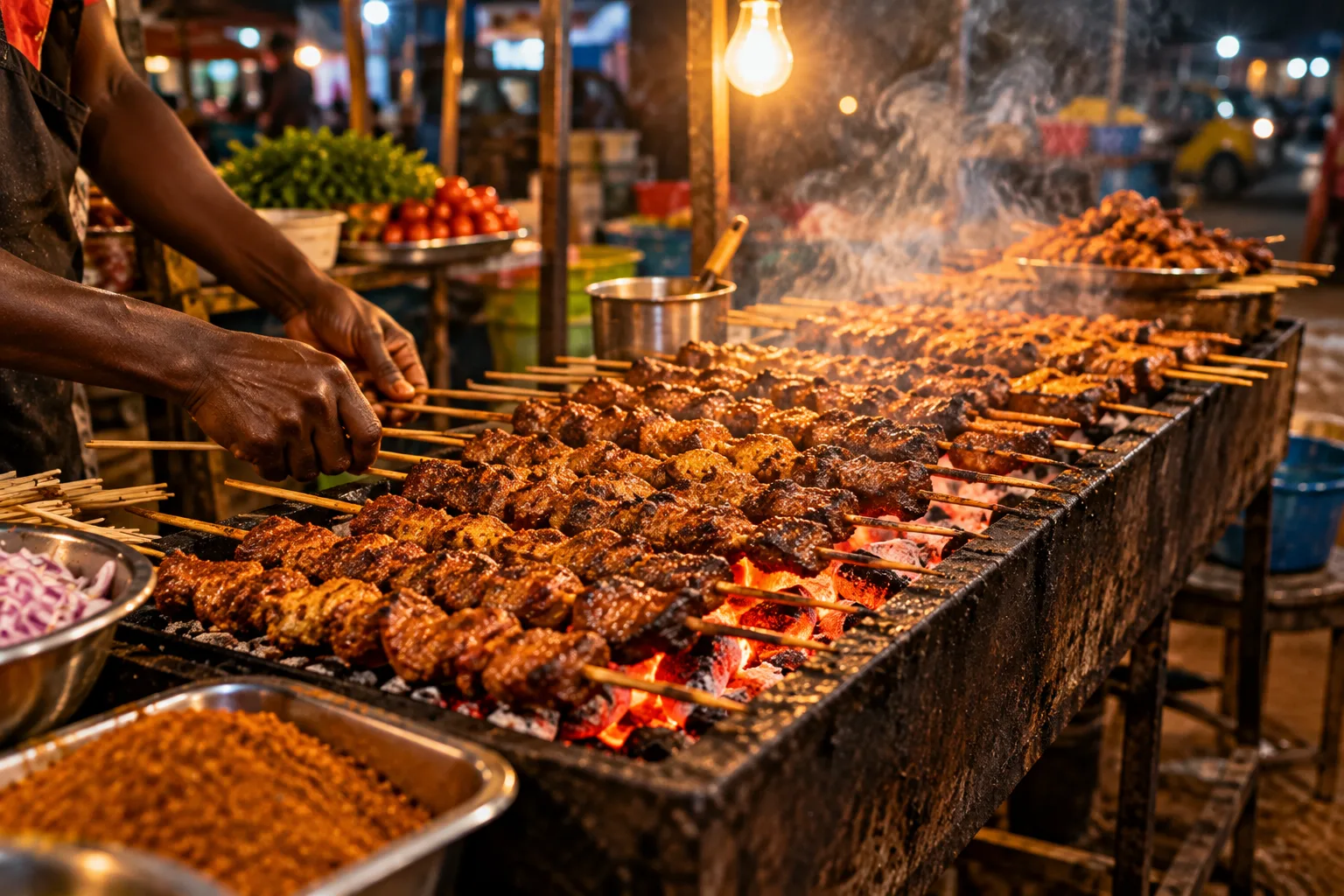
Then there is suya: thin beef skewered, coated in a peanut and spice mix called yaji, and grilled over open coals at night. It is the best-known street food of the region and the easiest entry point for anyone new to it.
The debt the Americas owe
West Africa did not merely influence the cooking of the Americas; in several cases it supplied the knowledge outright. Rice cultivation in the Carolina Lowcountry depended on expertise carried by enslaved people from the rice-growing regions of Senegambia and Sierra Leone — how to flood, drain, mill and cook it. Carolina Gold rice exists because of that expertise.
Okra, black-eyed peas, sorghum, watermelon and kola travelled the same route. So did technique: the one-pot rice dishes of the Americas — jambalaya, arroz con gandules, Brazilian arroz de hauçá — are recognisably related to jollof, and the frying, stewing and pounding methods of Southern and Caribbean cooking come from the same source. Gumbo takes its name from a West African word for okra.
Brazilian cooking in Bahia is the most direct survival of all: dendê palm oil, ground peanuts and dried shrimp in acarajé and vatapá are West African dishes that crossed an ocean and kept their names.
Empires, trade and the kola nut
The region’s food culture was built by wealth, not scarcity. The empires of Ghana, Mali and Songhai ran trans-Saharan trade in gold, salt and kola for centuries, and the movement of salt southward and kola northward shaped what people cooked and ate across a continent-sized network.
Kola itself is worth knowing. Bitter, caffeinated, chewed as a stimulant and exchanged formally at weddings, funerals and negotiations, it is a social object as much as a food — and it lent its name and originally its extract to the world’s most famous soft drink.

Where it stands now
This is the fastest-rising cuisine in the world in terms of attention. Nigerian and Ghanaian restaurants have moved from community kitchens to reviewed dining rooms in London, New York, Paris and Toronto over the past decade, helped by the same cultural export engine — music, film, fashion — that carried Korean food.
If you are starting: jollof with fried plantain, suya from a grill, and one bowl of egusi with pounded yam eaten by hand. The third one is where it stops being a novelty and starts being a cuisine.