

 Kayiwa · · 4 min read
There is no African cuisine. There are fifty-four countries, well over a thousand languages, and food cultures that share less with each other than Italy shares with Japan. A Moroccan tagine, a Nigerian jollof, an Ethiopian fasting platter and a South African braai have almost nothing in common except the continent printed on the map.
So this is an overview of what separates the regions, and a route into the deeper pieces.
The staple decides everything
The fastest way to understand African food is to ask what the starch is, because the starch organises the meal.
- West Africa — rice, cassava, yam and plantain. Pounded and fermented starches eaten with soups and stews.
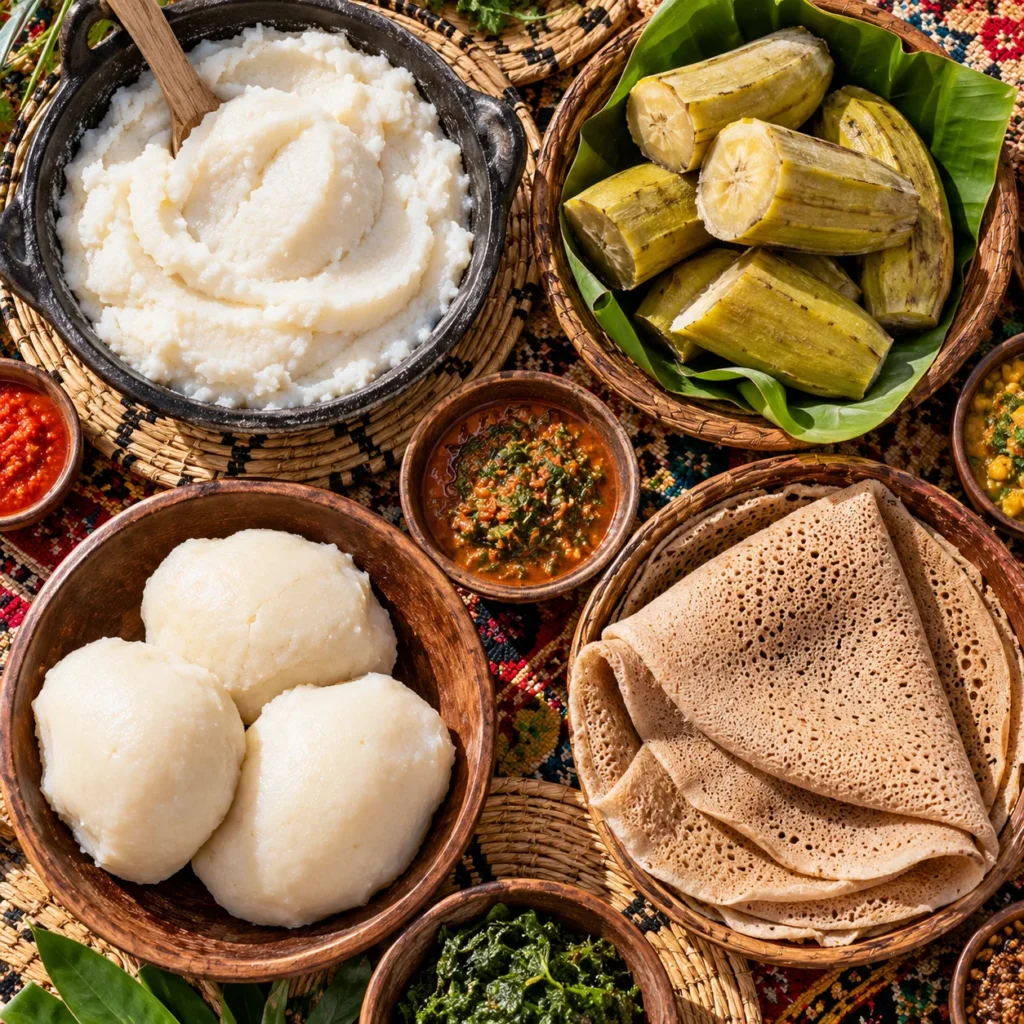
- East Africa — maize, bananas and teff. Stiff maize porridge across the region, matooke in Uganda, injera in Ethiopia and Eritrea.
- North Africa — wheat, in couscous and bread, with the Mediterranean and Arab worlds in the seasoning.
- Southern Africa — maize again, with grilling, and a strong Indian and Malay influence on the coasts.
Almost everywhere, the structure is starch plus sauce, eaten with the right hand, from a shared dish, with the starch as the vehicle. That is the single most consistent pattern across the continent, and it is the opposite of the European plate where the protein is the centre.
What Africa gave and what it was given
Coffee is Ethiopian. Okra, black-eyed peas, sorghum, millet, watermelon, kola and yam are African domesticates. Enslaved West Africans carried rice knowledge, okra and cooking technique to the Americas, where they built the foundations of Brazilian, Caribbean and Southern US cooking — a debt those cuisines are only now acknowledging properly.
In return, the Columbian exchange gave Africa maize, cassava, chilli, peanuts and tomato — every one of which is now so central to African cooking that removing them would collapse whole cuisines. Maize, the staple of eastern and southern Africa, has been there for only about four hundred years.
Southern Africa, briefly
The fourth region deserves its own note. Maize arrived and became pap or sadza, eaten with stewed greens and meat. Grilling — the braai in South Africa, and its equivalents across Zimbabwe, Botswana and Namibia — is a social institution rather than a cooking method.
The coastal cities carry something else entirely. Cape Malay cooking descends from people enslaved and brought from South-East Asia by the Dutch, and produced bobotie, koesisters and a spicing unlike anything inland. Durban has one of the largest Indian populations of any city outside India and invented bunny chow — curry served in a hollowed-out half loaf. Neither is a footnote; they are what happens when forced migration and indenture rewrite a regional diet.
Fermentation everywhere, rarely credited
Africa has one of the richest fermentation traditions on earth and receives almost none of the attention given to Korean or Japanese fermentation. Injera batter in Ethiopia, ogi and gari in West Africa, iru and dawadawa from locust beans, mahewu and umqombothi in the south, and the sour porridges that feed much of the continent are all controlled microbial processes refined over centuries.
They do real work: preserving food without refrigeration, making cassava safe to eat, raising nutritional value, and creating the sourness that shapes an entire palate. Any account of world fermentation that starts in East Asia and stops there is missing half the story.

Why the rankings ignore it
African cuisines sit near the bottom of global cuisine rankings, and the reason is structural rather than culinary. Those lists aggregate ratings of named dishes, which rewards cuisines with large restaurant footprints abroad and a long history of cookbooks and food writing in English. Most African food is cooked at home, documented orally, and carried abroad by communities cooking for themselves.
That is shifting. West African restaurants are opening well beyond the diaspora neighbourhoods, jollof has become a global argument, and Nigerian and Ghanaian chefs are being reviewed seriously in cities that ignored them a decade ago. Expect those rankings to move — not because the food improves, but because the counting finally reaches it.