

 Kayiwa · · 5 min read
There is no such thing as Chinese food. There are eight major culinary traditions, several dozen minor ones, and a north-south divide over the staple grain that is older than most countries. A Cantonese cook and a Sichuanese cook share an alphabet and disagree about almost everything else.
Older than almost anything
In 2005 archaeologists working at Lajia in Qinghai province lifted an overturned earthenware bowl and found a nest of thin yellow noodles underneath, preserved by the sediment that buried the site. They were made from millet, not wheat, and they were about four thousand years old. It remains the oldest direct evidence of noodles anywhere.
That depth matters, because it means Chinese cooking developed its core techniques — fermenting, steaming, drying, rendering, stir-frying — over millennia rather than centuries, and exported them across Asia long before Europe had any of them. The soy sauce on a Japanese table, the noodles in a Thai wok and the steamer in a Korean kitchen all point back here.
The eight traditions, briefly
The classical grouping is eight: Shandong in the north, the oldest, salt-forward and stock-driven; Sichuan, numbing and hot; Cantonese, steam and freshness and restraint; Jiangsu, precise knife work and sweetness; Zhejiang, light and fresh; Fujian, soups and seafood and a taste for the sour-sweet; Hunan, hotter than Sichuan but without the numbing; and Anhui, wild ingredients and slow braises.
Two of them dominate abroad. Cantonese emigration built most of the world’s Chinese restaurants, which is why a village in Europe knows sweet and sour pork and has never heard of a numbing broth. Sichuan came later and changed the conversation entirely.
Mala: the taste nobody warns you about
Sichuan food is defined by mala — ma meaning numbing, la meaning hot. The heat is chilli, which arrived from the Americas in the sixteenth century and was adopted so completely that it now seems native. The numbing is older and stranger: huajiao, the Sichuan peppercorn, which is not a peppercorn but the husk of a citrus relative, and which contains a compound that makes your lips buzz at roughly fifty vibrations a second.
It is a genuine physical effect rather than a flavour, and it changes what the chilli does: the tingle dulls and spreads the burn so you can keep eating heat that would otherwise stop you. A mapo tofu without it is a different dish wearing the same name.

Wok hei, and why your kitchen cannot do it
Cantonese cooks call it wok hei — the breath of the wok. It is the faint smoky sweetness in a good plate of beef chow fun, and it comes from food searing and flashing against metal hot enough to vaporise a film of oil, tossed so it never sits still long enough to stew.
Domestic hobs cannot produce it. A restaurant wok burner runs at an order of magnitude more heat than a home ring, and the round base concentrates it. This is the honest reason your home stir-fry tastes flat: not technique, not sauce, but the fact that you are steaming where a professional is scorching. Cook smaller batches, get the pan properly hot, and accept the ceiling.
Yum cha, and eating as a social form
Dim sum came out of the teahouses of Guangdong, where tea came first and small dishes were what you ate alongside it. The phrase yum cha means to drink tea, not to eat dumplings, and the order of those words is the whole point: it is a morning that lasts hours, with family, noise and trolleys.
Hotpot works the same way for a different generation. The pot sits in the middle, everything is cooked by the people eating it, and the meal takes as long as the conversation does. Modern chains turned it into an industry — the largest are now global, with branches in cities that have small Chinese populations — but the format is old and communal, and it is still the most fun way to eat in China.
Where it stands now
The restaurant culture inside China was interrupted in the twentieth century and rebuilt fast. Michelin arrived in Shanghai in 2016, Guangzhou in 2018 and Beijing in 2019, and the reaction was instructive: plenty of Chinese diners regarded a French tyre company grading Chinese restaurants as, at best, an outside opinion. The domestic rating apps carry far more weight locally, and if you are eating in China they are the better guide.
Abroad, the cuisine is finally being seen in parts rather than as one menu. Regional restaurants — specifically Sichuan, Hunan, Yunnan, Xinjiang, Dongbei — have opened in Western cities over the past fifteen years and changed what people expect. The old Cantonese-derived template that defined Chinese food for a century in Europe and America now looks like what it always was: one region’s cooking, adapted for people who had never eaten any other.
Global cuisine rankings put China in or near the top ten, which understates it. Those lists score on how widely dishes are eaten and rated, and most of the world has eaten one of eight traditions. Judged on range, technique and sheer historical depth, there is no serious argument for placing it anywhere but at the very top.
What to order, and where
- Mapo tofu in a Sichuan place — the benchmark dish. If your lips do not tingle, they left out the huajiao.
- Beef chow fun in a Cantonese place — the wok hei test, and the hardest cheap dish to cook well.
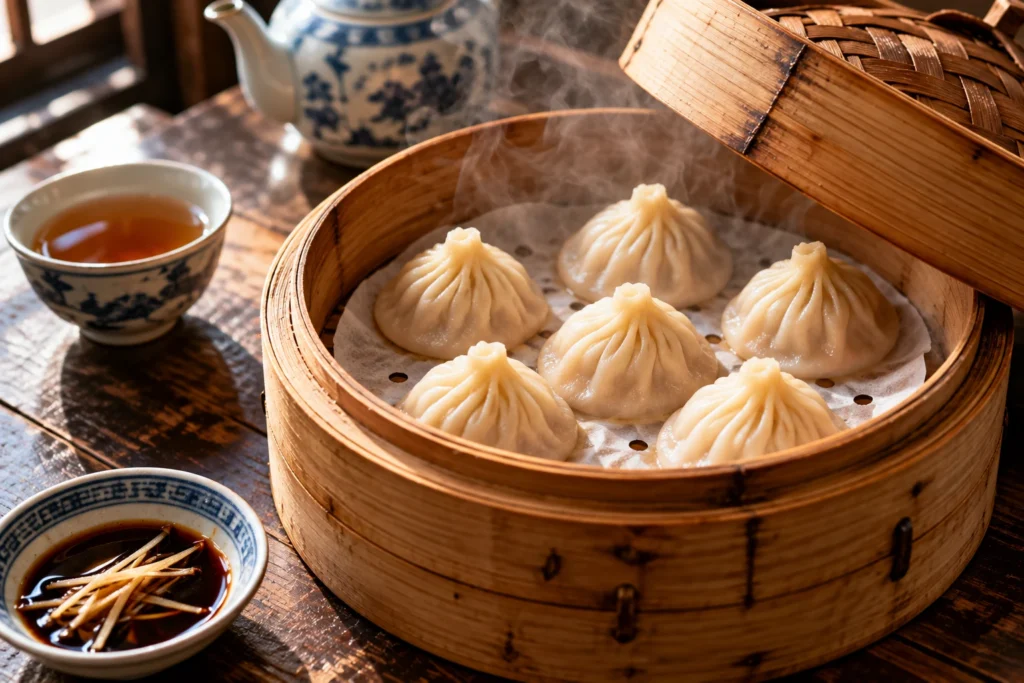
- Xiaolongbao in Shanghai — soup inside the dumpling, eighteen folds, eaten with vinegar and ginger.
- Hand-pulled lamian from a Lanzhou or Xinjiang shop — watch it being pulled, then judge the broth, not the noodle.
- Dim sum before eleven, with tea, and tap two fingers on the table when someone pours for you.
Costs, cities, visas and a route are in the China travel guide. I have also written about cooking hotpot at home.