
Selamat pagi for morning, selamat siang for midday.
Essentials- Capital
- Jakarta
- Currency
- Rupiah (Rp)
- Language
- Indonesian
- Best months
- May – Sep
- Visa
- VOA, 30 days
- Daily budget
- $35 mid-range
Bali is a single small island in a country of seventeen thousand, and it absorbs the overwhelming majority of foreign visitors. That is not an argument against going — Balinese food and Hindu culture are genuinely distinct from the rest of Indonesia, and worth the trip on their own. It is an argument for adding Java, which is two hours away, has the volcanoes, the temples and the better street food, and costs half as much.
The food across both is built on sambal. There are hundreds of regional versions and the good warungs make theirs fresh daily. Padang food, from Sumatra, is the country’s great export cuisine: a dozen pre-cooked dishes displayed in the window, you point, you pay for what you eat.
When to go
Jan: Avoid time to visit
Feb: Avoid time to visit
Mar: Mixed time to visit
Apr: Good time to visit
May: Best time to visit
Jun: Best time to visit
Jul: Best time to visit
Aug: Best time to visit
Sep: Best time to visit
Oct: Good time to visit
Nov: Mixed time to visit
Dec: Avoid time to visit
Best Good Mixed Avoid
Dry season May to September, and it is a clear distinction — the wet season brings genuine daily downpours rather than passing showers. July and August are peak in Bali, with prices and Canggu traffic to match. May, June and September are the sweet spot. Volcano hikes in Java need dry weather to be worth doing at all.
What it costs
| Item | Rate | Total |
|---|---|---|
| Guesthouse or homestay | $18 / night | $252 |
| Food and drink | $10 / day | $140 |
| Ferry, trains, one flight | — | $95 |
| Scooter hire and fuel | $5 / day | $70 |
| Temples, Borobudur, volcano guide | — | $130 |
| SIM, laundry, sundries | — | $28 |
| Fourteen days | $715 |
Borobudur and Prambanan are the expensive line — foreign-visitor pricing is roughly $25 and $18 respectively, and the Bromo or Ijen guided hikes are $35–60 each. Everything else is cheap. Java accommodation runs about half of Bali’s for the same standard.
What to eat
Nasi campur
Rp20–45k
Rice with a selection of small dishes — the everyday meal and the best way to eat at a warung. Every region’s version is different.
Babi guling
Rp50–90k
Balinese spit-roast suckling pig with crackling, lawar and blood sausage. A Hindu-island dish you will not find in Muslim Java. Go at lunch; it sells out.
Nasi padang
Rp25–50k
Sumatran. Dishes arrive unasked, you eat what you want and pay for those. Rendang, gulai, sambal ijo. The best value meal in the country.
Gudeg
Rp20–40k
Yogyakarta’s signature: young jackfruit slow-stewed in palm sugar and coconut for hours until it is sweet and mahogany-dark. Breakfast food.
Sate
Rp15–40k
Chicken, goat or rabbit, grilled over coconut husk with peanut sauce. Madura-style is the classic. Buy ten skewers, not five.
Bakso
Rp15–30k
Meatball noodle soup sold from carts and one of the great late-night foods. The cart bell is how you find it.
Where to base yourself
| Place | Notes | Nights |
|---|---|---|
| Ubud, Bali | Inland, cooler, and the food is better than the coast. Base outside the centre and walk in. | 3–4 nights |
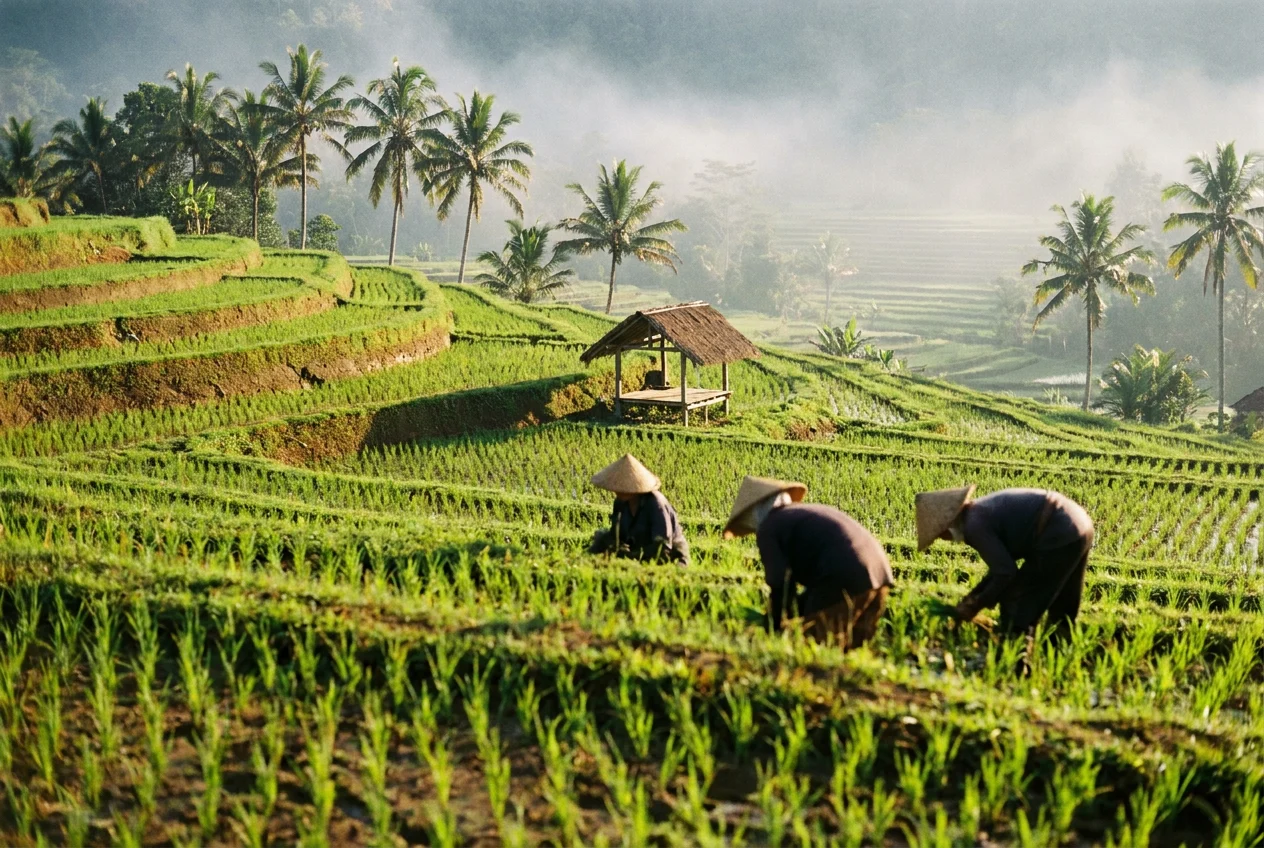
| Amed or Sidemen, Bali | East Bali, barely developed, with the rice terraces and diving. What Bali was. | 2–3 nights |
| Yogyakarta, Java | The cultural capital, Borobudur and Prambanan within reach, and the best street food in Indonesia. | 3–4 nights |
| Malang or Bromo area, Java | The volcano base. Cold at altitude — bring a jacket, which nobody does. | 2–3 nights |
A route that works
Arrive Denpasar, straight to Ubud
Skip the airport-area beaches entirely. Ubud in the afternoon, babi guling if it is before 2pm.
Ubud: market and rice terraces
Market at 6am before it turns into a souvenir hall. Tegalalang or, better, the Campuhan ridge walk.
Ubud: temples and cooking class
Goa Gajah and Tirta Empul early. A cooking class here is worth more than one in Thailand — the sambal technique is the takeaway.
East to Sidemen or Amed
Two hours by car. Rice terraces without the coaches, or the coast for diving the Liberty wreck.
East Bali: slow day
Snorkel, walk, eat. The first genuinely quiet day.
Fly or ferry to Java
Fly Denpasar to Yogyakarta (about $45, 90 minutes), or ferry to Banyuwangi and train west if you have the time.
Yogyakarta: city and food
Kraton palace, Taman Sari, then Malioboro area for gudeg and the night food carts.
Borobudur at sunrise
Leave at 4am. It is worth the alarm exactly once, and the light at 6am is the reason.
Prambanan and the countryside
The Hindu counterpart to Borobudur, less visited, arguably more beautiful. Afternoon in the villages by scooter.
Train east to Malang
Comfortable, cheap, scenic. Java’s trains are a genuine pleasure.
Bromo sunrise
Another 3am start, a jeep, and a caldera that looks like another planet. Bring the jacket.
Malang: coffee and recovery
The city is a pleasant surprise — Dutch colonial streets, good coffee, no tourists.
Ijen crater or back west
The blue-flame hike is a hard 2am climb with sulphur fumes. Rewarding, genuinely unpleasant, entirely optional.
Fly out from Surabaya or back to Bali
Either works. Surabaya has more international connections than people expect.
Practical notes
| Arrival declaration | An electronic customs declaration is required for every arrival, submitted within three days of landing at allindonesia.beacukai.go.id. Free. The e-VOA for the visa itself is separate, at evisa.imigrasi.go.id. | |
|---|---|---|
| Visa | Visa on arrival for most Western passports, 30 days, around $35, extendable once for another 30. An e-VOA is available online in advance and saves queueing. A customs declaration (e-CD) is required — do it before landing. | |
| Money | Cash-dominant outside Bali. ATM fees are high and machines cap withdrawals low, so plan around it. Use bank-branch ATMs, not the ones in convenience stores. | |
| SIM | Telkomsel has by far the best coverage across the islands. Around $10 for 30 days. Buy from an official store, not a street kiosk, to avoid registration problems. | |
| Transport | Gojek and Grab for cars and bikes in cities, but both are banned or restricted in parts of Bali where local transport co-operatives operate — expect to negotiate a car in those areas. | |
| Scooters | Ubiquitous and the main cause of tourist injury. An international licence with a motorcycle endorsement is legally required and increasingly checked. Helmets always. | |
| Water | Bottled or refill. Balinese "Bali belly" is usually raw vegetables or ice at cheap warungs rather than the water itself. | |
| Etiquette | Sarong and sash required at Balinese temples, usually provided. Java is Muslim-majority and more conservative in dress. Use your right hand. Do not touch anyone’s head. | |
| Tipping | Not expected; 10% is often added in restaurants. Rounding up for drivers and guides is normal. | |
Plan this trip
Booking links for the places in this guide, so you can go from reading to reserving without starting a new search.
Where to stay
Getting around
Some of these are affiliate links. If you book through one, I earn a small commission at no extra cost to you, and it never changes what goes in a guide. How this works.
Where your time is better spent
Kuta, Legian and most of Canggu. Traffic, chain restaurants and a version of Bali that has very little to do with Bali. If you want the coast, go east or north.
The Instagram infrastructure — the gates, the swings, the nests — is a paid queue for a photograph. Also skip Mount Batur sunrise if you are doing Bromo or Ijen; it is the least rewarding of the three and by far the most crowded.
Before you book
Visa rules, park fees and prices in this guide were checked in September 2026 and they move. Confirm entry requirements with your own foreign ministry and current fees with the relevant authority before committing money.
Say It Yourself
Back to the route
Twelve phrases in Indonesian
Indonesian is the most forgiving language here: Latin alphabet, no tones, no verb conjugation, and pronounced as written. A week of effort gets you genuinely far, and outside Bali almost nobody expects a visitor to try.
Same as Malay. Answer: sama-sama.
EssentialsSay it entering a shop or passing someone.
EssentialsOr sambal terpisah — sambal on the side.
EatingEnak alone is plenty.
EatingThe whole of warung ordering, in two words.
EatingLearn this before you land.
MoneyMarkets and drivers, not warungs.
MoneyBisa means can. Very useful.
MoneyOr just toilet, which is understood.
Getting aroundFor Gojek and Grab.
Getting aroundSlow them down without pretending.
Getting aroundOne to ten, for price tags
1satu
2dua
3tiga
4empat
5lima
6enam
7tujuh
8delapan
9sembilan
10sepuluh
Rupiah prices are long. Sellers say dua puluh ribu for 20,000 — ribu is thousand, and it is the word to listen for.
Indonesia Questions
The four I get asked most
Is Bali worth it in 2026?
Yes, if you go inland and east and treat the south coast as an airport you pass through. Ubud, Sidemen, Amed and the north still work. The southern beach strip is a different product entirely.
Do you need to visit Java?
Not need, but it is what makes an Indonesia trip rather than a Bali trip. Yogyakarta plus Borobudur plus a volcano is five days and roughly half the cost of the same time in Bali.
How difficult are the volcano hikes?
Bromo is barely a hike — a jeep and 250 steps. Ijen is three to four hours up in the dark with sulphur gas and requires a mask, which guides provide. Neither needs technical skill; Ijen needs willingness.
Is Indonesian food spicy?
The dishes often are not; the sambal on the side always is. That is the structure of the cuisine — you control the heat. Ask for sambal terpisah to have it served separately.
Guides like this one are researched in person and stay free to read. If this saved you time or money, you can buy me a coffee.
Never Miss an Adventure
Weekly travel tips, new videos and exclusive guides — straight to your inbox.